
 Available in US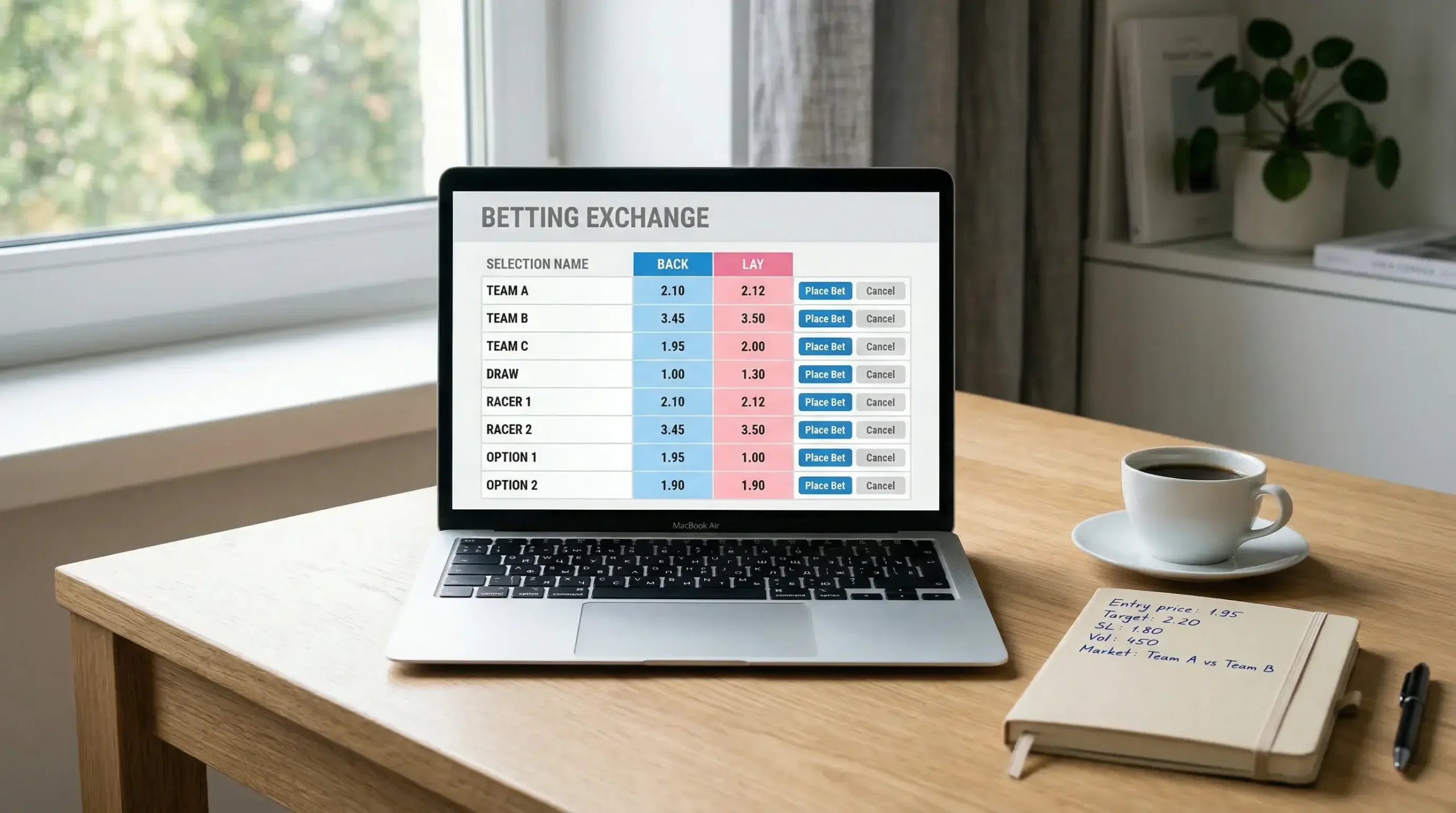
Betting exchanges offer ante-post bettors something no traditional bookmaker can: the ability to both back and lay a horse in the same market, trade positions as information changes, and set your own price rather than accepting one. The ante-post betting exchange landscape in the UK is dominated by three platforms — Betfair Exchange, Smarkets, and Betdaq — and choosing between them involves trade-offs in commission rates, market liquidity, and functionality that directly affect your bottom line.
This article profiles each exchange, compares their commission structures and liquidity profiles for ante-post racing markets, and assesses which platform best suits different types of ante-post activity. The exchange edge is real, but it is not uniform — and the platform you choose determines how much of that edge you keep.
Three UK Exchanges — Platform Profiles
Betfair Exchange is the largest and longest-established platform. Launched in 2000, it operates as part of the Flutter Entertainment group — the same company that runs Paddy Power, Sky Bet, and the Betfair Sportsbook. Flutter processed approximately 35 million bets during Cheltenham Festival 2024 across all its UK and Ireland brands, with more than 2.5 million active users, according to Flutter’s own figures. While that total spans all products, Betfair Exchange captures a significant share of the ante-post trading activity, particularly for major festival markets. Its depth of liquidity is unmatched among UK exchanges, which makes it the default choice for punters seeking to back, lay, or trade ante-post positions at scale.
Smarkets is the challenger. Established in 2010, it has positioned itself as a lower-commission alternative to Betfair, targeting price-sensitive bettors and professional traders. Smarkets offers a cleaner interface, a simplified commission structure, and competitive pricing on horse racing markets. Its liquidity has grown significantly in recent years but remains a fraction of Betfair’s in most ante-post markets, particularly for races outside the top tier.
Betdaq occupies the third position. Owned by Ladbrokes Coral — now Entain — it has operated since 2001 but has never achieved the critical mass of liquidity that Betfair commands. Betdaq periodically offers zero-commission promotions to attract volume, and it has a loyal user base among punters who prefer its commission structure or its interface. For ante-post markets, Betdaq’s liquidity is typically the thinnest of the three, which limits its utility for larger positions but can make it a useful secondary platform for smaller bets or for situations where its price differs from Betfair’s.
All three platforms operate under Gambling Commission licences and offer ante-post markets on the major UK racing fixtures. The structural difference between exchanges and traditional bookmakers is that exchange prices are set by the weight of money from other users, not by a trading team. This means that exchange odds often carry a lower effective overround — but the available price is only as good as the liquidity behind it.
Commission Rates and Liquidity — Where Your Edge Leaks
Commission is the exchange’s equivalent of the bookmaker’s overround — it is the cost of doing business, and it directly affects your net return on every winning bet. The differences between the three platforms are significant enough to influence which one you should use.
Betfair Exchange charges a baseline commission of 5 per cent on net winnings per market. This rate can be reduced through a discount programme based on betting activity, with the most active users paying as little as 2 per cent. For ante-post bettors who trade multiple positions across a season, the discount tier they achieve makes a material difference to net returns. A punter operating at 5 per cent commission on a 10/1 winner receives an effective payout of 10.45/1 after commission; at 2 per cent, the effective payout rises to 10.78/1. Over many bets, those fractions compound.
Smarkets charges a flat 2 per cent commission on net winnings, with no tiered discount structure. For punters who do not generate enough volume to reach Betfair’s lowest commission tiers, Smarkets offers a structurally lower cost on every winning bet. The simplicity of the flat rate is also an advantage: you know exactly what your net return will be before you place the bet, without needing to calculate which discount tier you have reached.
Betdaq’s commission has varied over time, with periodic promotions offering 0 per cent commission on specific markets. Its standard rate is typically around 2 to 5 per cent depending on the market, and it has used zero-commission campaigns aggressively to attract volume away from Betfair. On the first day of Cheltenham Festival 2025, Betfair Exchange saw turnover rise by 20 per cent year-on-year, while Betdaq reported a 75 per cent increase, according to Betangel community data. That disproportionate growth on Betdaq likely reflects the impact of promotional commission rates drawing volume from punters looking for the cheapest execution.
Liquidity and commission interact in a way that complicates the exchange edge. Betfair’s higher commission is offset by deeper liquidity — you can get matched at your desired price more reliably and at higher stakes. Smarkets’ lower commission is offset by thinner liquidity — the price may be better in theory, but you may not be able to get matched at it in meaningful size. For ante-post markets months before a festival, when exchange liquidity is at its thinnest, this trade-off is most acute. A 2 per cent commission on a bet you cannot get matched is worth nothing.
Which Exchange Works Best for Ante-Post Horse Racing
The best exchange for ante-post horse racing depends on what you are trying to do: back a position, lay one off, trade between prices, or hedge an existing bookmaker bet.
For backing a position — placing a straightforward ante-post bet through the exchange — Betfair is the default choice for the largest markets. Its liquidity on Cheltenham, Aintree, and Royal Ascot ante-post markets is sufficient to absorb stakes of several hundred pounds without moving the price. For smaller stakes, Smarkets offers a better net return through its lower commission, and the liquidity on major markets is usually adequate for bets under £100. Betdaq is a viable third option when it is running commission promotions, but its thinner books mean that ante-post prices can be less reliable as indicators of true market sentiment.
For laying — betting against a horse — Betfair’s liquidity advantage is most pronounced. Laying an ante-post selection requires someone on the other side of the market willing to back at your price, and the probability of getting matched in a timely fashion is highest on the platform with the most users. Smarkets can handle smaller lay bets on the top races, but for anything beyond the biggest markets, Betfair is the practical choice.
For trading — backing at a longer price and laying at a shorter one as the market moves — the exchange edge depends on how quickly the market reprices and how deep the liquidity is at each price point. Betfair’s depth makes it the only platform where ante-post trading at scale is consistently feasible. Smarkets is usable for smaller-scale trading, but the thinner order books mean that getting in and out of positions at the desired prices is harder, and the slippage — the gap between the price you want and the price you get — is wider.
For hedging a bookmaker ante-post bet — laying off on the exchange to lock in a profit — the commission rate becomes the dominant consideration, because the hedge is a single transaction and the net payout depends entirely on the commission charged on your winnings. Smarkets’ 2 per cent commission produces a better hedge return than Betfair’s 5 per cent, provided the liquidity is there to execute. The practical approach for hedging is to check both platforms, compare the available lay prices after commission, and execute on whichever offers the better net result.
The exchange edge is not captured by any single platform. It is captured by using the right platform for each type of transaction, monitoring all three, and choosing based on a combination of price, liquidity, and commission for each specific bet. That requires more effort than using a single bookmaker, but the reward — lower costs, better prices, and the ability to manage your ante-post positions actively — justifies the investment.
Betting Exchange Ante-Post — More on this topic at ascot betting offers.
See also Mobile Ante-Post Betting.
