


Ante-post betting on UK horse racing is the act of backing a horse before final declarations are confirmed — sometimes weeks, sometimes months ahead of the race. It is the oldest form of speculative wagering in the sport, and it remains the format where serious punters find the widest margins between their assessment and the bookmaker's price. Unlike a bet struck on the morning of the race, an ante-post wager locks in odds at a moment when the market is still digesting incomplete information: fitness reports are vague, the going is unknown, and the trainer's true intentions are anyone's guess. That uncertainty is precisely the point.
In practical terms, UK ante post horse racing separates the patient analyst from the casual punter. Day-of-race betting offers the comfort of knowing your horse will at least line up; ante-post strips that safety away. If your selection is withdrawn, injured, or simply re-routed to a different meeting, your stake is gone. No refund. No Rule 4 deduction. Just a lost bet. The trade-off is price. Bookmakers compensate for the additional risk by offering significantly longer odds, and those odds compress as race day approaches and information becomes public. Capturing value early — before the crowd arrives — is the essence of the ante-post game.
Ante-Post Timing & Price Compression
Bet now, wait, or take SP? Where the value really sits over time.
An ante-post price compresses as the race nears — the wide early odds shorten toward the starting price. But betting early carries the most non-runner risk. This projects your horse's price across four windows and shows where the value survives once that risk is priced in.
This guide is built around a single principle: an informed edge beats guesswork at any distance. Across the sections below, you will find the mechanics of how ante-post markets open and settle, a full breakdown of the rules that govern your stake, strategies used by profitable bettors, and hard data drawn from the Gambling Commission, the British Horseracing Authority, and major operators. Whether you are eyeing the Cheltenham Festival in the spring of 2026, plotting an Ascot portfolio for the flat season, or simply trying to understand why the non-runner no bet market is priced differently, this is the reference you need.
What Every Ante-Post Punter Needs to Know Before Committing Stakes
- Ante-post means betting before declarations — you get bigger odds, but there is no refund if your horse does not run. That single rule shapes every decision covered in this guide.
- Non-Runner No Bet removes the withdrawal risk, though it is only offered on selected markets and within limited windows. Check activation dates before assuming you are covered.
- Favourites win roughly 30–35% of UK races and just 32.1% at Cheltenham 2025 — early odds routinely overreact to form, giving patient bettors a genuine informed edge.
- Hedging on exchanges lets you lock in profit once your ante-post selection shortens. Flutter Entertainment alone processed approximately 35 million bets during Cheltenham 2024, with over 2.5 million active users — liquidity at that scale means there is always a market to trade against.
- Cheltenham dominates the ante-post calendar. William Hill projects industry turnover of around £450 million across the four days of the 2026 Festival — the largest wagering event in jump racing.
What Ante-Post Betting Means in British Horse Racing
Ante-post (from the Latin ante, before, and the English post, the starting post) — a bet placed on a horse race before final declarations are published. The punter accepts full risk of non-participation in exchange for odds that are typically longer than those available on the day of the race.
The concept is older than the modern bookmaker. In the early nineteenth century, turf accountants at Tattersalls would lay prices on Derby contenders months before Epsom, scribbling odds into leather-bound ledgers while trainers hedged their own runners through intermediaries. The punter who fancied a colt for the Two Thousand Guineas in January could secure a price that would look absurd by May — provided the colt stayed sound, the ground came right, and the trainer did not change plans. The same bargain holds today, except the ledger is a mobile app and the turf accountant is an algorithm.

What separates ante-post from day-of-race betting is not complexity but certainty. On the morning of a race, after declarations close and the overnight market forms, every horse listed will run barring a late withdrawal. Ante-post punters enjoy no such guarantee. They are betting into a field that does not yet officially exist. A horse can be supplemented, re-routed, retired, or injured between the moment the bet is placed and the moment the stalls open. The bookmaker prices that ambiguity into the odds, and the punter is rewarded for shouldering the risk.
British horse racing remains the natural home of ante-post wagering. According to the BHA 2025 Racing Report, racecourse attendance topped 5.031 million in 2025 — a 4.8% year-on-year rise and the first time the figure exceeded five million since 2019. That audience fuels a massive betting ecosystem: the global horse racing market was valued at $491.7 billion in 2025 and is projected to reach $530.2 billion by 2030, according to Deep Market Insights. The UK sits at the centre of that economy, and the ante-post market is where the sharpest money tends to land first.
Trainer John Gosden captured the symbiosis between racing and wagering bluntly: "The Gambling Commission does not understand the relationship between racing and betting. They should target online casinos and slot machines that sit in everyone's pocket." His frustration points to a structural truth. Ante-post markets do not merely reflect the sport; they fund it — through levies, sponsorship deals, and media rights that depend on betting turnover. Understanding how those markets work is the first step toward finding an informed edge within them.
How Ante-Post Markets Open, Move and Settle
Market opens — Bookmakers post initial prices, often months before the race. These early odds reflect rough assessments of form, stable reputation, and public interest rather than precise probability.
Odds move — Money flows in, and prices adjust. Trial races, injury reports, trainer interviews, and exchange activity all shift the market. A horse that wins a prep race impressively may halve in price overnight.
Declarations close — The BHA publishes confirmed runners (48 hours for Flat, varying for Jumps depending on meeting type). Non-declared horses are removed from the market.
Settlement — The bet settles at the odds taken, not the starting price. If the horse was an ante-post selection and did not run, the stake is lost. If the horse ran and won, the payout reflects the price locked in at placement.
The lifecycle of an ante-post market is essentially a repricing of uncertainty. When a bookmaker opens a market on, say, the Champion Hurdle six months out, the tissue price is little more than a statement of opinion. Trainers have not committed to the race, the going is unknowable, and half the entries may target different festivals. As months pass and information accumulates — a strong gallops report, a decisive trial win, an entry at the five-day stage — the market narrows. Odds that were 20/1 in October can be 5/1 by March. The ante-post bettor's profit lives in that compression.
One detail that escapes many newcomers: ante-post odds are fixed at the point of the bet. Unlike starting price bets, which settle at the odds available when the race begins, an ante-post wager pays at the price you took. This is a double-edged mechanism. If you backed a horse at 16/1 and it drifts to 25/1 on the day, you are stuck with 16/1. If it shortens to 4/1, you are sitting on a substantial edge — or, more usefully, a hedging opportunity on the exchanges.
The financial scale of this mechanism is considerable. Online horse racing betting turnover in the UK stood at £7.88 billion in the year to March 2025, down from £8.37 billion the previous year, according to Gambling Commission data reported by the Racing Post. That contraction has not dented the levy. The Horserace Betting Levy Board collected a record £108 million in the 2024–25 financial year — the fourth consecutive annual increase — even as underlying turnover fell, according to iGaming Business.
Gráinne Hurst, CEO of the Betting and Gaming Council, described the paradox: "For the fourth consecutive year, levy contributions have reached a record level. This demonstrates a long-term, growing investment from regulated betting into British racing. However, it is concerning that despite record contributions, betting turnover on racing continues to decline." For ante-post bettors, the implication is clear: the market is shrinking in volume but intensifying in value. Fewer casual bets mean odds can be slower to move, which creates windows for those paying attention.
Ante-Post Rules That Protect — and Expose — Your Stake
The defining rule of ante-post betting is simple and unforgiving: if your horse does not run, you lose your stake. No refund. No partial return. No Rule 4 deduction. This is the contract you enter when you back a horse before declarations close, and it applies regardless of the reason for withdrawal — injury, change of plan, death, or the trainer simply preferring a different engagement. The bet was placed on the assumption that the horse might not run, and the odds reflected that risk.
No Rule 4 protection on ante-post bets. Rule 4 deductions compensate bettors when a horse is withdrawn after the final market forms. Because ante-post bets are struck before that market exists, Rule 4 does not apply. If a rival withdraws and the field contracts, your payout remains at the original odds — but if your selection withdraws, the loss is total.
Non-Runner and Withdrawal
The non-runner clause is the core risk of ante-post. Consider a real scenario from jump racing: a punter backs a Champion Hurdle contender at 8/1 in November. The horse is training well, the stable is confident, early trials go smoothly. Then, three weeks before Cheltenham, the horse suffers a minor setback and is ruled out. The bet is dead. The odds were generous precisely because this outcome was possible, and the bookmaker priced it in. Understanding this is not optional — it is the foundation of every ante-post decision.
Balloted-Out Entries
In races with safety limits on field size — the Grand National is the obvious example — horses may be balloted out even after the entry stage. If your ante-post selection is balloted out, the bet is lost under standard rules. Some bookmakers offer Non-Runner No Bet terms on certain Grand National markets, but the default position is that a balloted horse is a non-runner, and a non-runner means a forfeited stake.
Postponement and Abandonment
If a race is postponed and rescheduled within a defined window (typically 24 hours, though this varies by bookmaker), ante-post bets usually stand. If the race is abandoned entirely or rescheduled to a different date, rules diverge between operators. Some will void ante-post bets on abandoned races; others treat them as losers. Always check the individual bookmaker's terms — there is no universal standard.
Each-Way Ante-Post
Each-way ante-post bets deserve specific attention. The place terms (typically 1/4 or 1/5 odds for a set number of places) are fixed at the time of the bet, based on the expected field size. If the field shrinks between placement and race day, you may find your place terms are more generous than those available on the morning of the race — a hidden benefit. This dynamic partly explains why each-way bets at Cheltenham rose 25% in 2024 compared to the previous year, according to analysis by Receptional. Punters are learning that each-way ante-post can offer structural value, not just a consolation payout.

The broader industry context matters here. Richard Wayman, Director of Racing at the BHA, has stated publicly that affordability checks are the leading cause of declining betting turnover. Losses from online horse racing betting have exceeded £1 billion since 2021, with independent consultancy Regulus Partners projecting a further £250 million shortfall over five years, according to a report published by the Racecourse Association. For ante-post bettors, affordability checks can directly affect your experience: accounts may be restricted or stakes limited on early-market bets where the bookmaker's risk exposure is longer. It is another layer of the ante-post landscape to navigate.
Non-Runner No Bet — How the Safety Net Works
Non-Runner No Bet (NRNB) — a promotion offered by bookmakers on selected ante-post markets, guaranteeing a full stake refund if your horse does not run. NRNB eliminates the primary risk of ante-post betting but typically comes with shorter odds and limited availability.
NRNB is the bookmaker's answer to the single biggest objection punters raise about ante-post betting: the fear of losing money on a horse that never reaches the start. Under NRNB terms, if your selection is withdrawn for any reason before the race, your stake is returned in full — usually as cash, occasionally as a free bet depending on the operator. It is the closest thing to a safety net that exists in futures racing markets.
The catch is availability. NRNB is not offered across all races or at all times. Bookmakers typically activate NRNB on the marquee festivals — Cheltenham, Aintree, Royal Ascot, the King George — and only within defined windows. For Cheltenham 2026, several major operators have opened NRNB markets from early autumn 2025, but the specific activation dates vary between firms. Some open NRNB once entries are published; others wait until the five-day declaration stage. The variation means you need to check each bookmaker's timeline individually rather than assuming blanket coverage.
The price difference between NRNB and standard ante-post odds reflects the bookmaker's cost of absorbing withdrawal risk. On a horse quoted at 10/1 ante-post, the NRNB price might sit at 7/1 or 8/1. That margin is the premium you pay for insurance. Whether it is worth paying depends on your confidence in the horse's participation. If you trust the trainer's public statements and the horse's vet record, the standard ante-post price delivers more value. If you are uncertain about fitness or commitment to the race, NRNB protects your bankroll.
The trend in NRNB availability has been broadly expansionary. As the recreational betting audience grows — the BHA reports that 68% of racecourse ticket buyers in 2025 were casual or first-time attendees, according to Deep Market Insights — bookmakers have recognised that NRNB lowers the barrier to entry for new customers who might otherwise avoid ante-post entirely. Expect more markets and earlier activation windows in 2026, particularly around Cheltenham, where the volume of ante-post activity dwarfs every other meeting on the calendar.
Advantages and Drawbacks of Betting Ante-Post
Advantages
- Better odds. The primary draw. Ante-post prices are longer than those available on the morning of the race because the bookmaker prices in the risk of non-participation. A horse that trades at 12/1 six months out may open at 5/1 on race day. The ante-post bettor captured the value early.
- Time to research. Ante-post markets open months in advance, giving you time to study entries, assess trainer patterns, track trial form, and build a case for your selection without the pressure of a ticking clock.
- Hedging opportunities. If your horse shortens significantly, you can lay it on an exchange (Betfair, Smarkets, Betdaq) to guarantee a profit regardless of the result. This converts a speculative bet into a calculated trade.
- Market inefficiencies. Early markets are thinner and less scrutinised than day-of-race markets. Bookmakers may underprice or overprice entries based on reputation rather than current form, creating pockets of value for attentive bettors.
Drawbacks
- No refund on non-runners. The defining risk. If your horse is withdrawn, injured, retired, or re-routed, the stake is gone. There is no safety net unless you specifically took NRNB terms.
- Capital locked up. An ante-post bet ties up your stake for weeks or months. That money cannot be deployed elsewhere, which matters if your bankroll is limited.
- Information asymmetry. Trainers know more than you do about their horse's condition. A public statement of confidence may not reflect private concerns about soundness, and by the time those concerns become public, the market has already moved.
- Odds can drift. You might back a horse at 10/1 only to see it drift to 16/1 as negative news emerges. Your bet is now underwater, and there is no mechanism to adjust the price.
The balance between these forces is what makes ante-post betting intellectually demanding. It is not for punters who need the reassurance of a confirmed runner, and it is not for those who bet impulsively. The ante-post bettor is, at heart, a trader: buying risk at a price they believe is too cheap, with the discipline to accept losses when the market moves against them.
Timing Your Ante-Post Bets — Data Behind the Decision
The timing window matters more than most punters think. Ante-post value does not stay constant — it peaks when information is scarce and compresses as declarations approach. The best prices exist early, but the best-informed bets come later. The skill lies in finding the intersection.
The conventional wisdom — "bet early, get the best price" — is only half right. Early prices are indeed longer, but they also carry the highest non-runner risk and the greatest information deficit. A more disciplined approach is to identify specific trigger points where you believe the market has mispriced a horse, then act on that assessment regardless of the calendar.
Data from the 2025 Cheltenham Festival illustrates the scale of activity around the event. According to Optimove Insights, 68.8 million bets were placed across multiple UK bookmakers during the 2025 Festival period. Active bettors surged 178–189% above baseline levels, while first-time deposits spiked by 310–417%. Those numbers reveal a flood of recreational money arriving in the final days before and during the Festival — money that moves odds sharply and often irrationally.
For the strategic ante-post bettor, this creates two distinct windows of opportunity. The first is the deep ante-post phase, roughly three to six months before a major festival. Prices here reflect stable reputation and general expectations rather than current form. If you have identified a horse whose progression is being undervalued — a novice hurdler stepping up from a quiet stable, for instance — this is the window where the edge is widest. The second window opens in the final two weeks before declarations, when trial results are complete, the going forecast begins to solidify, and trainers start making public commitments. Prices have shortened from their autumn levels but may still offer value relative to the starting price.
The dead zone between these windows — roughly January to late February for the spring festivals — is where ante-post bets are most likely to be mispriced in the wrong direction. This is when pre-Christmas hype has faded but trial form has not yet clarified the picture. Odds can drift artificially in this period, creating false signals. Patience here pays dividends.

Seasonal context also matters beyond Cheltenham. The flat season's ante-post markets for Royal Ascot and the Classics typically open in early spring 2026, with meaningful price movement after the Guineas trials in April and May. For the Grand National, ante-post interest peaks from January onward once handicap weights are published. Each calendar has its own rhythm, and timing your entry to the specific race cycle — rather than applying a one-size-fits-all rule — is part of building that informed edge.
Flat Season vs Jumps — Where Ante-Post Value Differs
| Factor | Flat | Jumps |
|---|---|---|
| Average field size (2025) | 8.90 | 7.84 |
| Premier field size (2025) | 11.02 | 9.41 |
| Favourite win rate | 30–35% | 27–33% (handicap to novice) |
| Market liquidity | High for Classics, moderate elsewhere | Very high for Cheltenham/Aintree, thin elsewhere |
| Ante-post window | Spring to summer (March–August) | Autumn to spring (October–April) |
| Key non-runner risk | Going preference, draw bias | Injury, going, trainer rotation between festivals |
The structural differences between flat and jump racing create distinct ante-post landscapes. Flat fields are larger on average — 8.90 runners per race in 2025, against 7.84 for jumps, according to the BHA 2025 Racing Report — which means more potential non-runners, wider-open races, and greater scope for value bets at longer prices. The flip side is that the ante-post market for a 20-runner Royal Ascot handicap is inherently more volatile than a market for a 10-runner Champion Chase.
Jump racing's ante-post markets are concentrated around a handful of festivals: Cheltenham in March, Aintree in April, the King George at Christmas, and the major Newbury and Ascot meetings in between. This concentration produces deep, liquid markets for the headline races and thin, unreliable markets for almost everything else. Flat racing, by contrast, spreads its ante-post interest across a longer season, from the spring Classics through to Champions Day in October, with Royal Ascot as the mid-season peak.
Turnover data from Q1 2025 reveals a further nuance. The BHA reported that average turnover per core race dropped 14.4% year-on-year, while turnover on Premier-rated races remained flat, according to Racing Post. The message for ante-post bettors: liquidity is migrating toward the biggest events. If you are betting ante-post on a mid-tier jumps race outside the festival calendar, expect wider spreads and less market efficiency.
The horse population itself is a factor. The number of horses in training in Britain fell to 21,728 in 2025, a 2.3% decline on the previous year, according to the BHA Racing Report. That contraction is felt more acutely in jumps, where attrition rates are higher and the training pipeline is longer. Fewer horses in training means fewer ante-post market options — and potentially less value if the same familiar names dominate the shortened lists.
In jumps, favourites in novice races win at roughly 33%, dropping to around 27% in handicaps, according to Grand National Fans. That gap matters for ante-post strategy: backing an early favourite in a novice hurdle is statistically more defensible than backing one in a competitive handicap chase, where the favourite's edge evaporates against a wider field of similarly rated runners.
The Big Ante-Post Festivals — Cheltenham, Aintree, Ascot and Beyond
Cheltenham Festival
No event dominates the UK ante-post calendar like the Cheltenham Festival. Held in mid-March, its four days of championship racing generate more ante-post turnover than any other fixture in jump racing. William Hill projects industry-wide betting turnover of around £450 million across the 2026 Festival. Lee Phelps, Head of Horse Racing Trading at William Hill, described the scale: "The battle between us and the punters over four days at Cheltenham Festival is unlike anything else in jump racing. We expect around £450 million in bets over four days, making it the biggest turnover racing festival of the year."
The numbers behind Cheltenham are staggering by any measure. Flutter Entertainment — parent company of Paddy Power, Sky Bet, and Betfair — processed approximately 35 million bets during the 2024 Festival, with over 2.5 million active users across its platforms, averaging roughly 14 bets per customer over the four days, according to Flutter's own data. By 2025, the industry total reached 68.8 million bets, according to Optimove Insights. These volumes create massive liquidity in ante-post markets, which in turn means tighter spreads and more opportunities for hedging as race day approaches.
Ante-post markets for Cheltenham 2026 opened in early autumn 2025, with the Champion Hurdle, Gold Cup, Champion Chase, and Stayers' Hurdle attracting the heaviest early activity. NRNB terms on these races are typically available from major operators by early January, though precise activation dates vary.
Aintree Grand National
The Grand National is the most publicly visible ante-post market in Britain. Its unique characteristics — large field, handicap conditions, and the drama of the Aintree fences — draw a casual betting audience that dwarfs most other races. Ante-post activity spikes when handicap weights are announced, typically in February, and again after the final entries and balloting process. The risk of being balloted out adds a layer of non-runner risk specific to the National.
Royal Ascot
For flat racing enthusiasts, Royal Ascot in June is the ante-post centrepiece. The five-day meeting features Group 1 races alongside some of the most competitive handicaps in European racing. Ante-post markets open after the spring trials, with the two-mile Queen Anne Stakes, the sprinters' contests, and the staying races all attracting sustained ante-post interest. Unlike Cheltenham, where jump form from the current season provides a solid data foundation, Royal Ascot ante-post betting often relies on interpreting Guineas form and early-season flat results — a different analytical skill set.

Prize Money and the Stakes Behind the Stakes
The quality of ante-post markets is underpinned by the prize money on offer. Total prize money in British racing rose 3.5% to £194.7 million in 2025, according to the BHA Racing Report. The Jockey Club announced further increases for 2026, with a total fund of £61.47 million across its racecourses — up from £58.1 million in 2025 — including an additional £1.375 million allocated to the Epsom Derby, according to BloodHorse. Higher prize money attracts better horses to the biggest races, which in turn deepens the ante-post markets and improves liquidity. For the bettor, richer races mean stronger fields, more competitive markets, and a greater chance of finding mispriced selections.
Five Ante-Post Strategies Used by Profitable Bettors
Value Detection Through Favourite Analysis
Core principle: If favourites win only 30–35% of UK races, then 65–70% of races are won by horses the market undervalued. Ante-post is where that undervaluation is most extreme.
At the 2025 Cheltenham Festival, favourites won 32.1% of the 28 races — nine victories from 28 contests — below the five-season average of 35.5%, according to William Hill's analysis. Those numbers are not a fluke; they reflect the inherent competitiveness of championship racing. The ante-post bettor who systematically avoids short-priced favourites and instead targets second- and third-tier contenders at value prices is playing the percentages. The question is never "will this horse win?" — it is "are the odds generous enough to justify the risk?"
The broader UK market data reinforces this. Overall betting turnover on British racing fell 6.8% in 2024 compared to the prior year, and 16.5% relative to 2022, according to the BHA Racing Report cited by iGaming Business. As casual money withdraws, the remaining market becomes sharper. Ante-post prices on obvious contenders compress quickly, while the less-fancied entries retain their value longer.
Reading Trainer Intent
Trainers are not obliged to tell you the truth about their plans, and many do not. A horse may be entered in three different festivals as an option, with the trainer waiting until the last moment to decide which target to pursue. The ante-post bettor who tracks entries, public statements, and — critically — what trainers do not say can gain an edge. A trainer who mentions a horse repeatedly in connection with one specific race is likely committed. A trainer who mentions multiple targets is keeping options open, which increases the non-runner risk.
Watch for supplementary entries. A trainer who pays a late-entry supplement for a major race is putting money behind their intent. That signal is worth more than any interview quote.
Ground Analysis
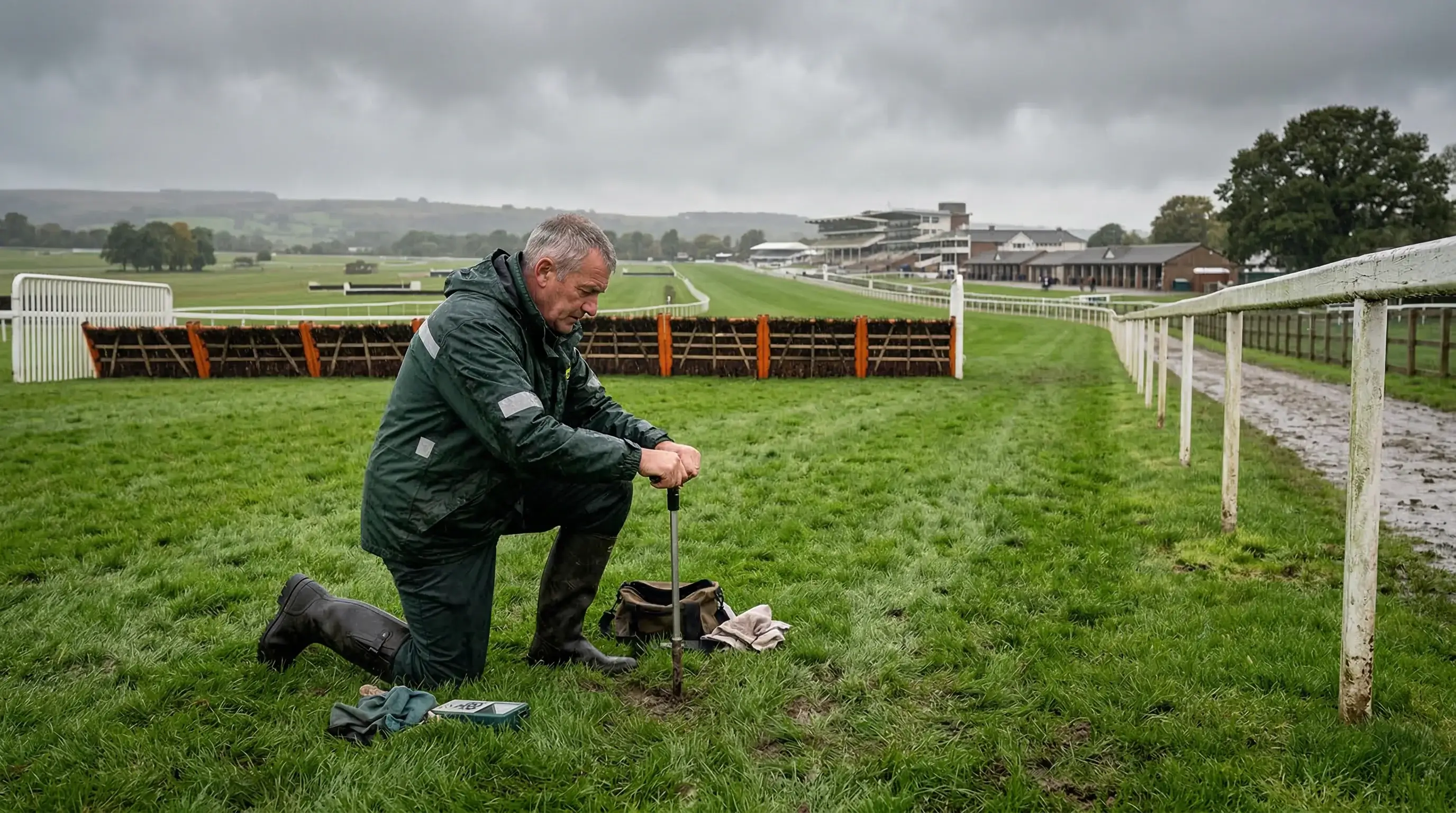
Going conditions are the single most unpredictable variable in ante-post betting, and they disproportionately affect jump racing. Research from Nottingham Trent University demonstrated that horse speed peaks on firmer surfaces but plateaus at a cushioning level of approximately 10 kilonewtons — roughly twice a horse's body weight. On softer ground, performance varies significantly, with some horses coping far better than others, according to NTU's findings.
Dr Jaime Martin of Nottingham Trent University noted: "Detailed assessment of sporting surfaces helps better analyse the state of the racecourse and make decisions on race day, with potential benefits for horse welfare and for those who bet on the sport." For the ante-post bettor, the practical takeaway is straightforward: if you are backing a horse that needs good ground and the long-range forecast suggests a wet spring, the odds may not compensate for that risk. Conversely, a proven soft-ground performer at a big price in a wet year is exactly the kind of value that ante-post rewards.
Timing Discipline
Not every ante-post bet should be placed at the earliest opportunity. As discussed in the timing section, the most profitable approach often involves waiting for a specific catalyst — a trial result, an entry confirmation, or a market overreaction — before committing. The disciplined bettor maintains a shortlist of targets, monitors the market daily, and strikes only when the odds offer a clear edge relative to their own assessment.
Portfolio Approach
Profitable ante-post bettors rarely put all their capital on a single selection in a single race. Instead, they build a portfolio across multiple festivals and markets, spreading risk across horses, trainers, and race types. A typical ante-post portfolio might include two or three Cheltenham selections, a Grand National each-way bet, a Royal Ascot outsider, and a Champions Day pick — each chosen for value rather than conviction. This diversification mirrors how professional investors manage equity portfolios: no single position is allowed to dominate the book.
Costly Ante-Post Errors — and How to Sidestep Them
The most expensive mistake in ante-post is not picking the wrong horse — it is misunderstanding the terms of the bet. Every error below stems from a failure to read the rules, check the data, or manage the bankroll.
Assuming NRNB applies when it does not. The most common and most costly error. A punter backs a Cheltenham contender at generous odds, the horse is withdrawn, and only then discovers the bet was placed on the standard ante-post market rather than the NRNB market. The difference between the two is displayed clearly on every bookmaker's site, but in the rush to secure a price, it is easy to select the wrong option. Always verify the market type before confirming.
Chasing last year's winner. Recency bias is powerful. A horse that won the Champion Hurdle last year will dominate public discussion and open as a short-priced favourite. But the ante-post value in that horse has almost certainly been extracted by the market before you get there. The bigger returns tend to come from the improver, the lightly raced prospect, or the horse switching codes — not from the defending champion at 3/1.
Ignoring the financial context. The UK's online horse racing betting market has contracted substantially. Gambling Commission data shows online turnover fell by £1.6 billion from 2022 levels, with the real-terms decline — accounting for inflation — reaching approximately £3 billion, as reported by Racing Post. A shrinking market means less casual money to push prices out of line, which in turn means fewer obvious mispricings and a need for deeper analysis to find value.
Over-committing to a single race. Staking your entire ante-post budget on one Cheltenham race is a recipe for volatility. If the horse does not run, or runs and disappoints, there is no recovery. A portfolio approach — smaller stakes across multiple races and festivals — smooths the variance and keeps the bankroll intact through inevitable losses.
Neglecting the exchange hedge. If your ante-post selection shortens from 14/1 to 5/1, you have the option to lay it on an exchange and lock in a profit regardless of the outcome. Failing to hedge when the maths supports it is leaving money on the table. This is not about greed or conviction; it is about disciplined capital management.
Ante-Post Glossary — Every Term from Rule 4 to SP
Ante-post — a bet placed before final declarations for a race are confirmed. The bettor accepts the risk that the selection may not run.
Declarations — the formal confirmation by trainers that their horse will run in a specific race. For UK Flat races, 48-hour declarations are standard. Jump racing declaration windows vary by meeting.
Non-Runner No Bet (NRNB) — a promotional term offered by bookmakers on select ante-post markets, guaranteeing a full stake refund if the selected horse does not run.
Rule 4 — a Tattersalls rule that allows bookmakers to make deductions from winnings when a horse is withdrawn after the final market has formed. Rule 4 does not apply to ante-post bets.
Starting Price (SP) — the official odds of a horse at the moment the race begins, as determined by on-course bookmakers. Ante-post bets settle at the price taken, not at SP.
Each-way — a bet in two parts: one on the horse to win, one on the horse to place (finish in the top 2, 3, 4, or 5 depending on field size and race type). Place terms are fixed at the time of an ante-post bet.
Balloted out — when a horse is removed from a race because the field exceeds the maximum safety limit. Treated as a non-runner for ante-post purposes.
Tissue price — the initial set of odds compiled by a bookmaker or odds compiler when a market first opens. It represents an early estimate of probability rather than a market-tested price.
Lay (exchange) — betting against a horse on a betting exchange. Used by ante-post bettors to hedge a position when their selection shortens in price.
Going — the ground conditions at a racecourse, ranging from firm to heavy. A critical variable in ante-post assessment, particularly for jump racing.
Supplementary entry — a late entry into a race made after the initial entry stage, usually requiring an additional fee. A strong signal of trainer intent for ante-post purposes.
Levy — the statutory charge paid by bookmakers to the Horserace Betting Levy Board, used to fund prize money, racecourse improvements, and horse welfare.
Frequently Asked Questions
What happens to my ante-post bet if the horse does not run?
Under standard ante-post rules, your stake is lost if the horse does not run. This applies regardless of the reason for withdrawal — injury, change of target, retirement, or being balloted out of the race. There is no refund and no Rule 4 deduction. The only exception is if you placed your bet on a Non-Runner No Bet (NRNB) market, in which case your stake is returned in full. NRNB markets are available only on selected races and within specific time windows, so always verify the market type before placing your bet. If in doubt, the market name and terms will be displayed clearly on the bookmaker's bet slip.
Is ante-post betting worth it compared to betting on race day?
Ante-post betting offers longer odds than race-day betting because the bookmaker prices in the risk of non-participation. A horse that opens at 16/1 ante-post might be 6/1 on the morning of the race. If you are confident in the horse's participation and form, ante-post delivers significantly better returns per pound staked. However, the trade-off is real: you accept the risk of losing your stake if the horse does not run, and your capital is locked up for the duration. Ante-post is most rewarding for bettors who research entries, track trainer intentions, and have the discipline to hedge on exchanges when their selection shortens. For casual punters who prefer certainty, race-day betting or NRNB ante-post markets are more appropriate.
When do ante-post markets open for Cheltenham and other major festivals?
Ante-post markets for the Cheltenham Festival typically open in the autumn prior to the March meeting — usually September or October — with all major UK bookmakers offering prices on the four championship races (Champion Hurdle, Champion Chase, Stayers' Hurdle, and Gold Cup) from the outset. Markets for other Festival races expand as the season progresses and trial form clarifies the picture. NRNB terms on Cheltenham races are generally available from January or February, depending on the operator. For Royal Ascot, ante-post markets open in the spring after the Guineas trials. Grand National ante-post markets attract significant interest from January onward, with a spike when handicap weights are published. Each festival has its own timeline, and the best prices are available earliest — though the best-informed bets tend to come closer to declarations.
Sources and Further Reading
- British Horseracing Authority — 2025 Racing Report
- Horserace Betting Levy Board — Record Levy Collection 2024–25 (via iGaming Business)
- Gambling Commission — Industry Statistics (Annual Report, April 2024 – March 2025)
- Racecourse Association — Affordability Checks Impact Assessment
- Nottingham Trent University — Ground Condition and Racehorse Performance
- Optimove Insights — Cheltenham Festival Betting Data 2025–2026
- William Hill — Cheltenham Festival 2026 Betting Projections
- Flutter Entertainment — Cheltenham Festival 2024 Betting Data
