
 Available in US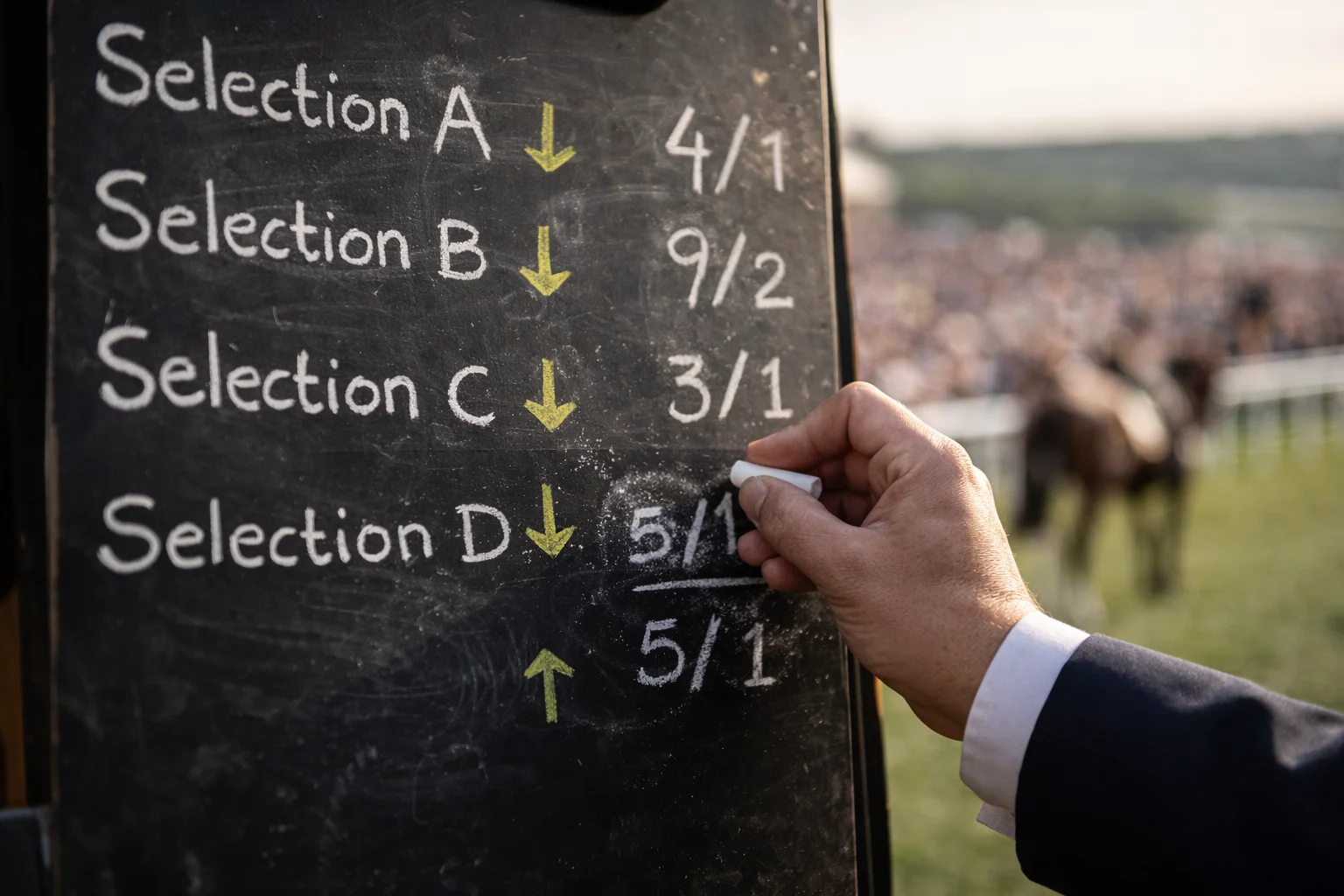
Ante-post prices move for reasons. Sometimes the reason is public — a trial-race result, an injury announcement, a trainer interview. Sometimes it is not. The art of reading ante-post market movers is the art of distinguishing signal from noise: working out whether a shortening horse represents genuine inside information, a promotional bookmaker move, or simply a wave of casual money that will recede as quickly as it arrived.
For ante-post bettors, market movement is not just background activity. It is data. A horse that drifts from 8/1 to 14/1 over a fortnight is telling you something. A horse that shortens from 16/1 to 10/1 across multiple firms in the space of 48 hours is telling you something louder. The question is always the same: follow the money, or fade it? This article breaks down the mechanics of ante-post price movement — sustained support, sustained drift, promotional cuts, and genuine gambles — and explains how to respond to each.
Sustained Support and Drift — Two Sides of Ante-Post Movement
Sustained support in an ante-post market looks like this: a horse is available at 14/1 on Monday. By Wednesday, it is 12/1 with two firms and 11/1 with a third. By Friday, the general price is 10/1. No public news explains the move. No trial race has been run. The trainer has said nothing in the press. Yet the market is contracting around this horse in a way that suggests real money — not casual punts — is behind the movement.
This kind of sustained shortening across multiple operators is one of the strongest signals in ante-post betting. It typically indicates that well-connected money — from within the horse’s ownership group, stable staff, or professional punters with access to private information — is backing the selection. The information might be as simple as a positive gallop report, a confirmed race target, or a vet’s clean bill of health. Whatever the cause, the money arrives before the news does, and the price adjusts accordingly.
Exchange volumes provide a complementary signal. On the first day of Cheltenham Festival 2025, turnover on Betfair Exchange rose by 20 per cent compared with the previous year, with Betdaq reporting a 75 per cent increase, according to Betangel community data. Those surges in exchange volume often concentrate around specific runners, and the horses attracting the heaviest exchange support in the weeks before a festival are frequently the ones that the traditional bookmaker market has been shortening on for days or weeks. Cross-referencing bookmaker price movement with exchange volume gives a fuller picture of where the money is flowing.
Drift — sustained lengthening of the price — carries the opposite message. A horse that drifts from 6/1 to 10/1 over three weeks, without public explanation, is a horse the market is losing confidence in. The causes range from private knowledge of a setback to a reassessment of the horse’s chance in light of rival form. Drifts that begin at the exchange level and ripple through to bookmaker prices are particularly instructive, because exchange prices respond faster to informed money. When you follow the money and the money is leaving, the correct response is usually to let it go.
Informational Money vs Promotional Price Cuts
Not every price move is informational. Bookmakers also cut prices for promotional reasons — to drive engagement, attract new customers, or generate social media discussion. Distinguishing a genuine market move from a promotional one is essential for any bettor attempting to follow the money accurately.
Promotional price cuts have identifiable characteristics. They tend to appear at a single firm rather than across the market. They are often accompanied by marketing — a social media post, a push notification, or a banner on the firm’s website. They may be tied to a specific event such as the launch of NRNB terms or a campaign around a festival. And they rarely move the broader market: if one bookmaker cuts a horse from 10/1 to 7/1 but no other firm follows, the cut is likely promotional rather than informational.
Informational moves, by contrast, propagate. When real money moves, it does so across multiple platforms, because the backers — whether individuals or syndicates — spread their stakes to avoid detection and to get the best average price. A horse shortening from 12/1 to 9/1 across five bookmakers simultaneously is almost certainly an informational move. No single firm’s marketing department coordinates price changes across its competitors.
Nevin Truesdale, CEO of The Jockey Club, has observed that the Gambling Commission’s approach appears oriented toward reducing betting to small-stakes activity — a stance he has criticised as misguided. That regulatory pressure affects the market-mover landscape in a subtle but important way: as large-stakes punters are pushed toward lower stakes or offshore platforms, the informational signal from bookmaker price movements may weaken, because the money that moves markets most is precisely the money being constrained. For ante-post punters who rely on reading market signals, this erosion of liquidity from high-staking bettors means that fewer moves carry the same weight they once did.
The practical filter is to ask three questions when you see a move: is it across multiple operators, is it sustained over hours or days rather than minutes, and is there an absence of promotional framing? If all three answers are yes, the move is likely informational. If any answer is no, scepticism is warranted.
How to Spot and Respond to an Ante-Post Gamble
An ante-post gamble is a concentrated, aggressive shortening of a horse’s price — typically from long odds to significantly shorter odds in a matter of hours or a few days. Gambles are the most dramatic market moves in ante-post betting, and they demand a clear-headed response.
Classic ante-post gambles tend to follow a pattern. The horse is initially available at a big price — 25/1 or longer — in a market where public attention is focused elsewhere. Over 24 to 48 hours, the price contracts sharply. First one bookmaker cuts, then another, then a third. By the time the move is visible to casual punters scanning odds comparison sites, the price may have halved. The speed and coordination of the move suggest a single source or a small group of connected backers acting with conviction.
The question is whether to join the gamble or let it pass. History suggests caution. Many ante-post gambles are based on genuine information — a horse that has worked exceptionally well at home, a trainer who has privately confirmed a target — but genuine information does not guarantee a winner. A horse that is backed from 33/1 to 12/1 has seen its implied probability rise from 3 per cent to about 8 per cent. That is still a roughly 92 per cent chance of losing. The gamble may be well-founded, but it does not make the horse a likely winner; it makes it a more likely winner than the market previously thought.
The timing of gambles also matters. In the first quarter of 2025, turnover on core British racing fell by 14.4 per cent while Premier fixtures held steady, according to BHA data reported by Racing Post. That uneven landscape means gambles on lower-profile races may move the market more dramatically than on Premier fixtures, simply because the liquidity is thinner and fewer opposing opinions are expressed in the market. A gamble that slashes a horse from 20/1 to 10/1 on a Pertemps qualifier is less robust than the same move on a Cheltenham Gold Cup contender, because the thinner market is easier to push around.
The disciplined response to an ante-post gamble is to assess it against your own pre-existing analysis. If you had already identified the horse as interesting at its original price, the gamble confirms your view and you should consider acting — though at the reduced price, not the original one. If the horse was not on your radar, the gamble alone is insufficient reason to get involved. Follow the money when it aligns with your own work. When it does not, the smartest move is often no move at all.
Ante-Post Market Movers — More on this topic at ascot betting offers.
See also Ante-Post Betting Sites.
