
 Available in US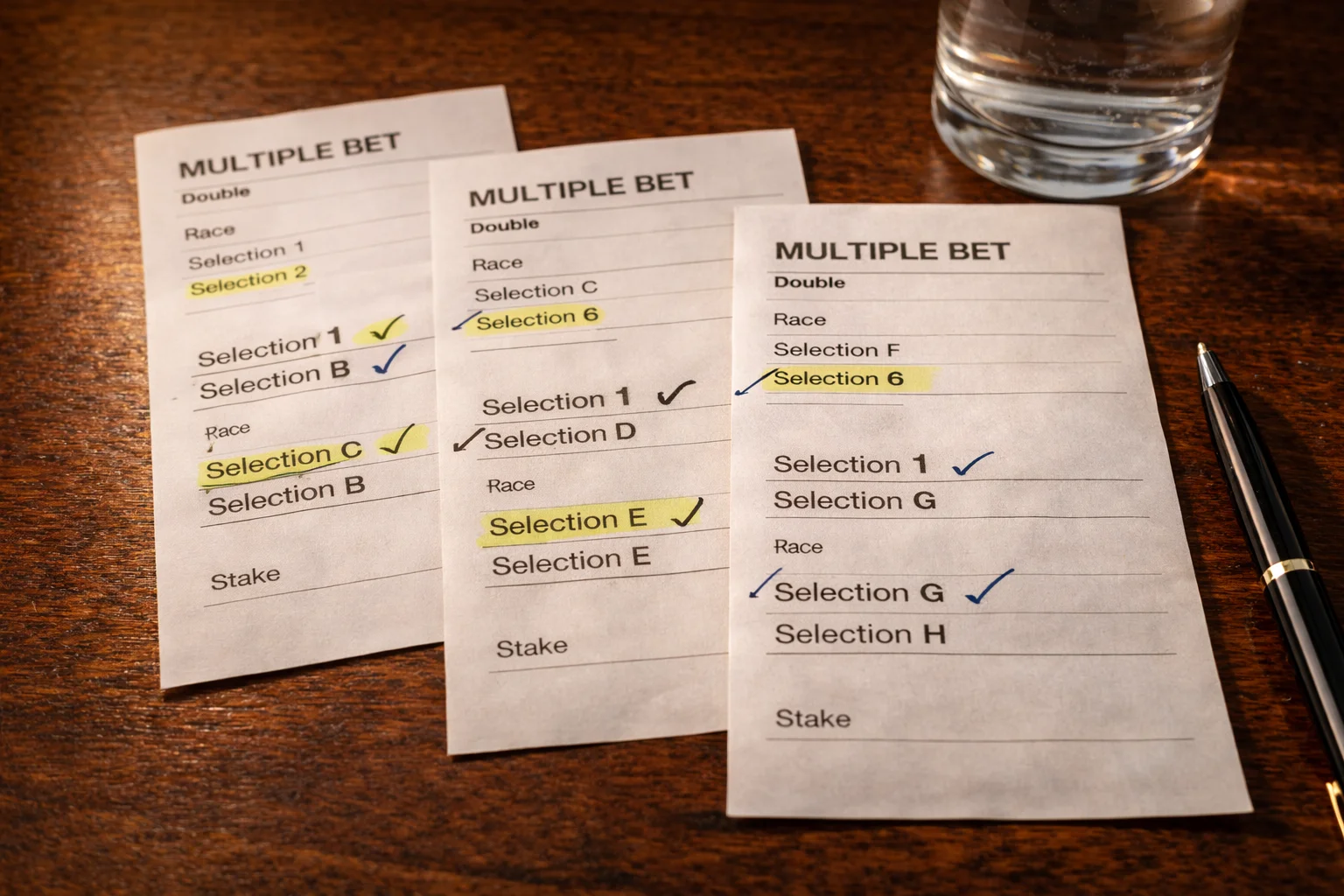
Backing a single horse ante-post is one kind of commitment. Combining two or more ante-post selections into a double, treble, or accumulator is another kind entirely — one that multiplies both the potential return and the multiple exposure you carry. Ante-post doubles rules are not always intuitive, and they differ between bookmakers in ways that matter when a leg of your bet falls through.
Ante-post multiples sit in an unusual regulatory space. Standard accumulator rules assume every selection either wins or loses in a settled race, but ante-post markets introduce a third possibility: the selection never runs at all. How that third outcome is handled — void, loser, or reduced to the remaining legs — depends entirely on the bookmaker’s terms, and those terms are not uniform across the industry. This article explains the settlement mechanics of ante-post doubles and trebles, what happens when one leg is a non-runner, and which UK bookmakers accept ante-post accumulators in the first place.
How Ante-Post Doubles and Trebles Are Settled
An ante-post double works like any other double: you select two horses in two different races, and both must win for the bet to pay out. The return from the first winning selection rolls onto the second, producing a combined payout that is the product of the two sets of odds. A 10/1 winner and a 6/1 winner in a double returns 77/1 on the original stake. The appeal is obvious — large returns from modest outlays.
Where ante-post doubles diverge from standard doubles is in the settlement of legs that never resolve on the track. In day-of-race multiples, every horse in the bet runs (or is a late withdrawal covered by Rule 4). In ante-post multiples, a horse may be withdrawn weeks before race day, and standard ante-post rules mean you lose your stake on that selection with no refund. The question is what happens to the remaining legs.
The scale of ante-post accumulator activity is substantial, even if it is rarely broken out in industry figures. Flutter Entertainment processed approximately 35 million bets during Cheltenham Festival 2024 across Paddy Power, Sky Bet, and Betfair, with over 2.5 million active users — an average of roughly 14 bets per person over four days, according to Flutter’s own data. A significant proportion of those bets were multiples linking runners across different days of the Festival. Dom Crosthwaite, Flutter’s Chief Trading Officer, noted that the company’s UK and Ireland online brands handled staking well in excess of £250 million across the Festival week, with over 37 million online bets processed, according to a separate Flutter press release — a figure that underscores how deeply multiples are embedded in Festival betting.
Trebles and four-fold accumulators follow the same principle with additional legs. Each added leg amplifies the odds but also amplifies the exposure: the probability that at least one horse fails to run increases with every leg added. In an ante-post context, this is not a marginal consideration. If each leg carries an independent 10 per cent non-runner probability, a four-fold accumulator has roughly a 34 per cent chance of losing at least one leg to withdrawal before a single race is run. That arithmetic is the reason serious ante-post bettors tend to favour singles and doubles over longer multiples.
What Happens to Your Multiple When One Leg Drops Out
This is the crux of ante-post multiples and the point where bookmaker policies diverge most sharply. When one leg of an ante-post double is a non-runner, three outcomes are possible depending on the operator’s terms.
The first and most common treatment is that the non-running leg is settled as a loser, and the entire multiple is lost. Under strict ante-post rules, a horse that does not run is a losing selection, full stop. If your ante-post double included a horse that was withdrawn three weeks before the race, the double is void in practical terms — but your stake is not returned. This is the default position for most traditional bookmakers when both legs are placed at ante-post prices.
The second treatment, offered by some firms, is that the non-running leg is voided and the multiple is reduced to the remaining legs. A double becomes a single; a treble becomes a double. Your bet is still alive, but the payout is based on the surviving selections only. This is considerably more punter-friendly but less common in ante-post markets than in day-of-race multiples. Where it does apply, it usually requires that Non-Runner No Bet terms are active for the relevant race.
The third, and rarest, treatment is full void — the entire bet is cancelled and your stake returned. This happens only in narrow circumstances, typically when the race itself is abandoned or voided entirely, not when a single horse is withdrawn.
The variation between these three outcomes can mean the difference between losing £50 and keeping a live bet that still has value. The lesson is unglamorous but essential: read the specific terms for ante-post multiples before placing the bet. The terms page on a bookmaker’s site — not the promotional banner, not the bet slip summary — is where the actual rules live. And those rules can differ not just between bookmakers but between markets and time periods. A NRNB-eligible race in Cheltenham week may apply void-the-leg treatment; a non-NRNB race on the same card will apply loser treatment. Within a single accumulator, different legs can be subject to different non-runner rules.
The multiple exposure compounds further with each-way multiples. An ante-post each-way double means four separate bets: win-win, win-place, place-win, place-place. If one leg is a non-runner, the treatment of the place portions follows the same rules as the win portion — but the total stake at risk is four times what a win-only double would involve. The complexity escalates quickly, and without a clear understanding of the terms, the punter is operating blind.
Which Bookmakers Accept Ante-Post Accumulators
Not all UK bookmakers accept ante-post accumulators, and among those that do, the rules and restrictions vary enough to make comparison worthwhile.
The major high-street and online operators — bet365, William Hill, Paddy Power, Coral, Ladbrokes, Sky Bet, Betfair Sportsbook — generally permit ante-post doubles and trebles on major races, particularly around Cheltenham, Aintree, and Royal Ascot. Four-folds and upwards are less consistently available; some firms cap ante-post multiples at trebles, while others allow longer accumulators but impose maximum payout limits that effectively discourage them.
Over 80 per cent of bets placed during the 2024 Cheltenham Festival came via mobile devices, according to Receptional. That mobile dominance has pushed bookmakers to make their ante-post multiple functionality more accessible in apps — quick-add selections, betslip builders, and pre-loaded Festival accumulators. But app convenience can mask the underlying terms. A bet slip that allows you to combine four ante-post selections does not guarantee that all four legs carry the same non-runner rules.
Betting exchanges — Betfair Exchange, Smarkets, Betdaq — do not offer traditional accumulator functionality. Each market on an exchange is settled independently, so you cannot place a single combined bet linking two or more exchange-traded ante-post markets. What you can do is back individual selections and manage the positions separately, effectively creating a synthetic multiple where the risk and return are in your hands rather than bundled into one bet slip. This requires more capital and more active management but gives you control that a bookmaker accumulator does not.
The practical advice is to check three things before placing an ante-post multiple: whether the bookmaker accepts the combination at all, what the non-runner treatment is for each leg, and what the maximum payout cap is. If any of those answers is unclear, the right platform for that bet is probably elsewhere — or the bet should be broken into singles where the terms are simpler and the multiple exposure is easier to quantify.
Ante-Post Doubles & Multiples — More on this topic at ascot betting offers.
See also Ante-Post Each-Way Betting.
