
 Available in US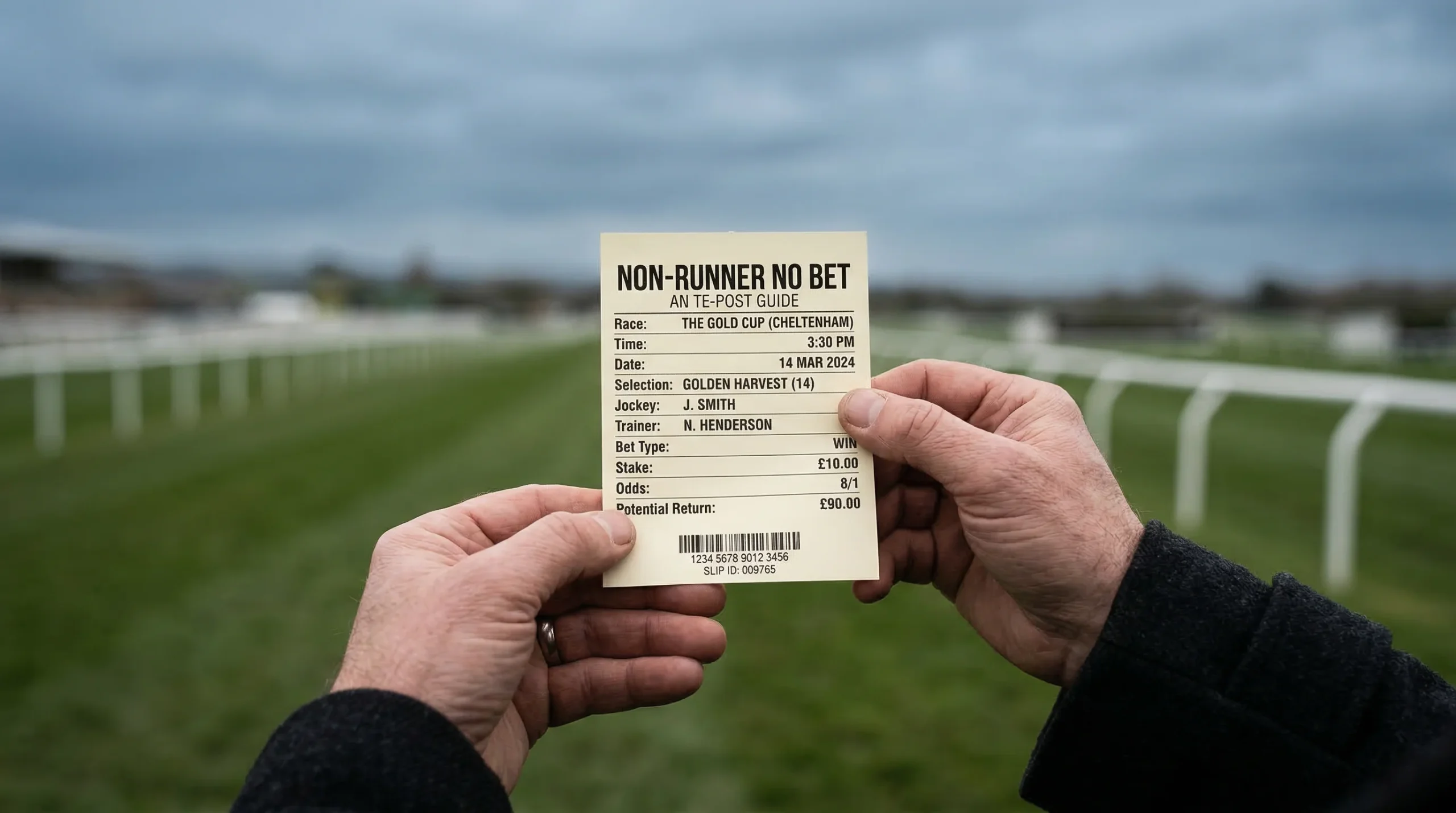
Non-Runner No Bet — four words that reshape the entire risk profile of an ante-post wager. Under standard ante-post rules, if your horse does not make it to the start, your stake is gone. NRNB reverses that outcome: the bookmaker refunds your stake in full if the selection is a non-runner. It sounds straightforward, and at the surface level it is. But treating NRNB as a blanket safety net without understanding its conditions, activation windows and market restrictions is a reliable way to misallocate your ante-post budget.
This guide is not a primer on what ante-post betting means — if you need that, start with the basics. It is built for punters who already understand the format and want to know exactly how NRNB works beneath the marketing. Which bookmakers offer it, and when does it switch on? Which markets qualify and which are excluded? How does the presence of NRNB change the expected value of a bet, and what does it cost you in the form of shorter odds? These are the questions that matter once you move past the initial relief of knowing your stake is protected.
The reality is that NRNB is a safety net with limits. It covers specific races, at specific bookmakers, from specific dates, under specific conditions. Outside those parameters, the standard ante-post rule applies and your stake is at risk. Understanding where the net holds and where it has holes is essential to building an ante-post portfolio that balances opportunity against exposure — particularly on the major National Hunt festivals where non-runner rates are highest and the stakes are largest.
How NRNB Alters the Risk-Reward Balance
At its core, NRNB works like an insurance policy embedded in the bet. You place an ante-post wager at the advertised price, and if the horse does not run, the bookmaker returns your stake as cash or free bet credit — the precise form of refund varies by operator. If the horse runs and wins, you are paid at the ante-post odds you originally took. If it runs and loses, you lose your stake as normal. The protection only activates on the non-runner scenario, and it only applies if the bet was explicitly placed under NRNB terms.
That last point is critical. NRNB is not retrospectively applied to existing bets. If you backed a horse in October under standard ante-post terms and the bookmaker later activates NRNB on that market in January, your October bet does not convert. You would need to place a new wager under the NRNB window to receive the protection. Some bookmakers make this distinction clear at the point of bet placement; others bury it in the terms. Checking whether your bet slip explicitly states NRNB before confirming the wager is the minimum due diligence.
Why Bookmakers Offer NRNB
From a commercial perspective, NRNB exists to stimulate ante-post activity — particularly among less experienced bettors who are put off by the risk of losing their stake on a non-runner. The strategy makes sense in context. According to BHA data reported by Deep Market Insights, 68% of racegoers buying tickets in 2025 were casual or first-time visitors to a racecourse. Many of these newcomers are interested in having a bet on the big festivals but are understandably reluctant to commit money weeks in advance when the horse might not even run. NRNB removes that barrier.
For the bookmaker, the cost of refunding non-runner stakes is offset by the volume of additional bets it generates and by the margin built into the odds. NRNB prices are typically shorter than the equivalent standard ante-post price on the same horse at the same bookmaker. The difference might be a point or two at longer odds — 10/1 under standard terms versus 9/1 under NRNB — or it might be more pronounced at shorter prices. The bookmaker is pricing the insurance into the odds, which means you are paying for the protection whether you realise it or not.
How the Refund Works in Practice
When a horse covered by NRNB is confirmed as a non-runner, refunds are usually processed automatically. Most operators credit the stake back to the customer’s account within 24 hours of the non-runner announcement, though the exact timeline depends on the bookmaker’s systems and the timing of the withdrawal. If a horse is pulled out weeks before the race, the refund may come through the same day. If it happens close to declarations, there can be a short delay while the operator confirms the status.
Some bookmakers refund NRNB stakes as cash, meaning the money returns to your withdrawable balance with no conditions. Others refund as free bets, which must be used on another wager before you can withdraw the value. The distinction matters, because a free bet is worth less than cash — you do not receive the stake back from a winning free bet, only the profit. A £20 NRNB refund paid as a free bet at 5/1 returns £100 in profit rather than the £120 (stake plus profit) you would receive from a cash bet. Over time, this difference compounds, particularly if you are placing multiple NRNB-protected bets across a festival card.
The refund mechanism also has implications for each-way bets placed under NRNB. If you back a horse each-way and it becomes a non-runner, both the win and place portions of the stake are refunded. However, the form of that refund — cash or free bet — applies to the combined stake, not separately to each component. If the bookmaker refunds as a free bet, the full each-way stake returns as a single free bet rather than two separate wagers.
NRNB Offers by Bookmaker — Activation Dates and Conditions
The biggest practical variable in NRNB is not whether a bookmaker offers it, but when they activate it and under what conditions. Every major UK-licensed bookmaker runs some form of NRNB promotion around Cheltenham, the Grand National and Royal Ascot. Fewer offer it year-round, and the activation dates, qualifying races and refund terms differ enough between operators that the same bet can carry protection at one bookmaker and none at another.
Activation Windows
Most bookmakers activate NRNB on Cheltenham Festival markets somewhere between early January and early March. The precise date is a competitive lever — operators announce their NRNB windows as part of their festival marketing, hoping to attract early ante-post money. In recent years, the trend has been towards earlier activation, with some operators offering NRNB from the point of the initial ante-post market opening for flagship races like the Champion Hurdle and Gold Cup.
For the Grand National, NRNB activation typically begins around the time of the weights announcement in February, though some bookmakers extend it earlier for the outright winner market. Royal Ascot sees NRNB activation from late April or early May, broadly coinciding with the trials season on the Flat. Smaller festivals — the Punchestown Festival, Aintree outside the National, the July Cup meeting — receive less consistent NRNB coverage, and some operators do not offer it at all on these fixtures.
The practical challenge for punters is that these dates are not standardised across the industry. Bookmaker A might activate NRNB on Cheltenham markets from 1 January; Bookmaker B might not switch it on until 1 March. If you place a bet in February, the first bookmaker protects you and the second does not — even if the odds are identical. Keeping track of activation dates across multiple operators is tedious but necessary if NRNB protection is part of your ante-post approach.
Conditions and Exceptions
Even within an active NRNB window, conditions apply. The most common restrictions include minimum odds thresholds — some bookmakers only offer NRNB on selections at 4/1 or longer, excluding short-priced favourites from the promotion. Others cap the refund amount, meaning that stakes above a certain level (often £250 or £500) are not fully covered. A few operators limit NRNB to specific bet types, excluding each-way wagers or accumulator legs.
Free bet refunds carry their own conditions. Expiry periods range from 48 hours to 14 days, and some bookmakers restrict free bet usage to specific sports or markets. A NRNB refund that arrives as a free bet with a three-day expiry and a horse-racing-only restriction is less flexible than one paid as unrestricted cash. Reading the promotional terms before committing stakes is the only way to understand what you are actually getting.
The Mobile Factor
One area where NRNB has evolved rapidly is mobile delivery. According to analysis by Receptional, more than 80% of bets on the Cheltenham Festival in 2024 were placed via mobile devices. That shift has pushed bookmakers to integrate NRNB signposting into their apps — tagging qualifying markets with NRNB badges, sending push notifications when NRNB windows open, and making the protection status visible on the bet slip before confirmation.
This is broadly positive for punters, because it reduces the chance of accidentally placing a standard ante-post bet when an NRNB option was available. But app design is not uniform. Some bookmakers display NRNB status prominently on the market page; others require you to drill into the bet slip or promotional terms to confirm whether the protection applies. If you are placing ante-post bets on your phone — and statistically, you probably are — take the extra ten seconds to verify NRNB status before hitting confirm.
Comparing Operators
Rather than ranking bookmakers — whose NRNB terms change from season to season — the more useful approach is to identify the variables that matter and check them for each operator before the festival season begins. Those variables are: activation date (when NRNB begins for each race), qualifying races (which markets are covered), minimum odds (whether short-priced selections qualify), refund format (cash or free bet), refund cap (maximum protected stake), each-way eligibility (whether both parts of an EW bet are covered), and expiry conditions (if the refund is a free bet, how long you have to use it). Building a simple comparison across these seven dimensions for the three or four bookmakers you use most will take less than an hour and will save more than that in misplaced stakes over the course of a season.
Which Ante-Post Markets Qualify for NRNB
Not every ante-post market qualifies for NRNB, and the distinction between covered and uncovered markets is where most punter assumptions break down. The general rule is that NRNB applies to outright winner markets on selected flagship races — but what counts as a flagship race, and which bet types qualify, varies by bookmaker.
Championship Races vs Handicaps
The most widely covered markets are the championship races at major festivals: the Champion Hurdle, the Queen Mother Champion Chase, the Stayers’ Hurdle and the Cheltenham Gold Cup at the Cheltenham Festival; the Grand National at Aintree; and the major Group 1 races at Royal Ascot. These are the races that attract the highest volume of ante-post betting and the most media attention, which is precisely why bookmakers extend NRNB to them — the promotional value of offering protection on the Gold Cup is higher than on a midweek handicap at Haydock.
Handicap races receive patchier NRNB coverage. Some bookmakers offer NRNB on the most prominent handicaps — the Coral Cup, the County Hurdle, the Plate at Cheltenham — but many do not. The reasoning is partly commercial (handicaps have larger fields and higher non-runner rates, making NRNB more expensive to underwrite) and partly structural (the turnover on individual handicap markets is lower, reducing the promotional return). If you are betting ante-post on handicaps, assume NRNB does not apply unless the bookmaker explicitly confirms otherwise.
The sheer scale of festival betting underlines why these distinctions matter. Data from Optimove Insights recorded 68.8 million bets placed across multiple UK bookmakers during the Cheltenham Festival 2025, with first-time deposits surging by 310% to 417% compared with baseline levels. A significant portion of that activity would have been driven by punters entering NRNB-protected markets — particularly newcomers who see the promotion as a low-risk way to participate in the festival.
Bet Types That Qualify
Most NRNB promotions cover single win bets as the default. Each-way bets are covered by some operators but not all — check the terms before assuming both parts of your stake are protected. Accumulator legs present a different challenge. If one leg of a four-fold is a non-runner under NRNB, most bookmakers void that leg and settle the remaining accumulator as a treble. However, some operators void the entire bet, which is a materially different outcome. The treatment of multiples under NRNB is the most inconsistent area across the industry, and it is the one most likely to generate disputes.
Place-only bets, forecast bets and speciality markets (such as without-the-favourite or top trainer) almost never qualify for NRNB. These are considered separate markets with their own settlement rules, and the NRNB umbrella does not extend to them. If you are placing exotic ante-post bets, you are doing so under standard terms regardless of any NRNB promotion running on the outright winner market for the same race.
How NRNB Changes Expected Value of Your Ante-Post Bet
Every NRNB offer has a price. It might not appear on the bet slip as a separate charge, but it is embedded in the odds. Understanding how NRNB changes the expected value of your ante-post bet requires looking at three components: the probability of winning, the probability of not running, and the difference in odds between NRNB and standard ante-post markets.
The Implied Cost of Protection
Suppose a horse is priced at 10/1 under standard ante-post terms and 8/1 under NRNB at the same bookmaker. The two-point difference represents the bookmaker’s pricing of the non-runner risk. In expected value terms, the standard bet offers a higher potential payout but carries the risk of total loss if the horse doesn’t run. The NRNB bet offers a lower payout but eliminates that risk. Which is the better bet depends on the probability that the horse actually makes it to the start.
If there is a 10% chance the horse doesn’t run, the expected value of the standard 10/1 bet is: (0.90 × probability of winning × 10) minus (1 × stake), adjusted for the 10% non-runner probability where the entire stake is lost. The NRNB bet at 8/1 removes the non-runner penalty: (probability of winning × 8) minus (1 × stake), with the stake returned in the non-runner scenario. For horses with high non-runner risk — those with a history of setbacks, or trained by yards known for late withdrawals — the NRNB price can represent better value despite the shorter odds.
For horses with very low non-runner risk — established, sound campaigners from reliable yards — the standard price typically offers superior expected value because you are being compensated for a risk that is unlikely to materialise. The question is always the same: how likely is this horse to not run, and is the odds difference between NRNB and standard pricing a fair reflection of that probability?
Favourite Win Rates and NRNB Value
The value of NRNB also depends on where your selection sits in the market. Data from Honest Betting Reviews shows that favourites in UK horse racing win approximately 30% to 35% of races across Flat and Jump codes, with the figure dropping to around 27% in handicaps. If you are backing a short-priced favourite ante-post with NRNB, the protection is relatively expensive as a proportion of the potential return — you are paying a premium on a bet that was already short-priced. If you are backing a 20/1 outsider, the NRNB cost as a proportion of the potential return is smaller, and the protection is arguably more valuable because outsiders are more likely to be withdrawn (they tend to be less established horses with less certain campaigns).
A useful rule of thumb: NRNB adds more value to your position when backing horses at longer odds with uncertain fitness or campaign profiles, and less value when backing short-priced favourites from established stables. The former group is where non-runner risk is genuinely elevated and the insurance justifies the cost. The latter group is where you are paying for protection you are unlikely to need.
Calculating the Break-Even Non-Runner Rate
You can calculate the non-runner probability at which NRNB and standard ante-post pricing offer equivalent expected value. If the standard price is 10/1 and the NRNB price is 8/1, the break-even non-runner rate is approximately 18%. If you believe the horse has a greater than 18% chance of not running, NRNB is the better bet. If you believe it is less than 18%, the standard price offers better value. This calculation will not be precise — estimating non-runner probability is inherently subjective — but it gives you a framework for deciding when the protection is worth the cost and when it is not.
What NRNB Does Not Cover
That framework helps you decide when NRNB is worth the cost, but expected value calculations only capture the non-runner scenario. NRNB protects against one specific outcome — the horse not running — and nothing else. The list of what it does not cover is longer than many punters assume, and the gaps in that protection are where losses accumulate.
Moved to a Different Race
If your horse is entered for the Champion Hurdle and connections reroute it to the Stayers’ Hurdle, your NRNB-protected bet on the Champion Hurdle is void — the horse did not run in the race you bet on — and your stake is returned. But if you backed the horse because you wanted exposure to that specific runner, the refund does not help you. You now need to place a new bet on the Stayers’ Hurdle, potentially at shorter odds and potentially without NRNB protection on the new market. The practical result is that you are back to square one, having lost time and possibly value.
Reduced Fields and Market Changes
NRNB does not protect against the race changing shape around your selection. If you back a horse at 12/1 under NRNB for a race expected to attract a full field, and half the field is subsequently withdrawn, the each-way terms may shrink, the competitive dynamics of the race shift, and your original assessment may no longer hold. The horse runs, so NRNB does not trigger, but the bet you placed is not the bet you expected to settle. This is particularly relevant in championship races where one dominant withdrawal can transform the market — a 12/1 shot becoming a 5/1 contender in a weakened field is a different proposition entirely.
Ground Changes and Fitness Doubts
NRNB does not protect against a horse running badly. If your selection lines up on ground it hates, or runs below par because of an undisclosed fitness issue, your NRNB protection is irrelevant — the horse ran, and the bet stands or falls on the result. This is a common source of frustration: a horse that was clearly not right but still ran, finishing tailed off, while the punter’s NRNB protection sat unused. Trainers have their own reasons for running horses that are not at their best — maintaining entries, earning prize money, giving a horse experience — and those reasons do not align with the punter’s interest in having the bet voided.
The Wider Market Context
The limitations of NRNB sit within a broader industry context that affects how bookmakers structure their ante-post products. The horse racing betting market in Britain has been under sustained pressure from regulatory intervention. Martin Cruddace, CEO of Arena Racing Company, warned in a letter to the Secretary of State that further affordability measures could cost the industry more than £250 million over five years, stating that there was “absolute consensus” that such measures would damage the sport, as reported by the Racecourse Association.
For NRNB specifically, regulatory pressure affects the generosity and scope of promotions. If bookmaker margins are squeezed by compliance costs and declining turnover, the commercial case for offering broad NRNB coverage weakens. Some operators may narrow their NRNB windows, raise minimum odds thresholds, or shift refunds from cash to free bets — all of which reduce the effective value of the protection to the punter. Monitoring these changes season to season is part of managing your ante-post approach.
Using NRNB as Part of a Wider Ante-Post Approach
Treating NRNB as a standalone feature misses its real value. The protection is most effective when integrated into a broader ante-post approach that considers timing, bookmaker selection, stake allocation and exit planning. Here is how to use it structurally rather than reactively.
Tiering Your Ante-Post Portfolio
The simplest framework is to divide your ante-post bets into two categories: positions that require NRNB and positions that do not. Horses with uncertain campaign profiles — those returning from injury, running for the first time at a new trip, or trained by yards with a pattern of late festival withdrawals — belong in the NRNB tier. You accept the shorter price because the non-runner risk is real and quantifiable. Horses with sound preparation, established form over the course and distance, and connections who have publicly committed to the race belong in the standard ante-post tier. You take the bigger price because you are being compensated for a risk that is unlikely to materialise.
This tiering approach prevents the common mistake of defaulting to NRNB on every bet and systematically paying for protection you do not need. It also prevents the opposite error — ignoring NRNB entirely and losing multiple stakes to non-runners over the course of a festival season.
Timing NRNB Bets Around Activation Windows
If you want NRNB protection on a specific horse, the activation date at your preferred bookmaker determines the earliest you can place the bet with cover. Placing the bet before the NRNB window opens means you are under standard terms regardless of what happens later. Some punters solve this by placing two bets: a small standard ante-post wager early in the season when prices are longest, and a larger NRNB bet once the protection window opens. The first bet captures the best price; the second provides the safety net with limits on the bulk of the stake. The combined position offers both value and protection, though it requires more active management than a single bet.
Combining NRNB with Exchange Hedging
NRNB and betting exchange hedging are not mutually exclusive. If you back a horse under NRNB at 10/1 and the price shortens to 4/1 as the race approaches, you can lay the horse on an exchange to lock in profit. If the horse then becomes a non-runner before declarations, your NRNB stake is refunded and your lay bet on the exchange is voided (since the horse did not run). You keep the refund and lose nothing on the exchange — a clean exit. This combination only works if the exchange market is liquid enough to place a meaningful lay bet, which is typically the case for championship races at major festivals but less reliable for smaller markets.
When to Skip NRNB Entirely
There are scenarios where NRNB is unnecessary or counterproductive. Betting on race-fit, proven horses with short-priced odds in markets where the NRNB margin compresses your value is one. Betting on races where the bookmaker only offers NRNB as a free bet refund — and you know from experience that converting free bets at full value is difficult in the remaining ante-post markets — is another. The goal is not to use NRNB on every bet, but to deploy it selectively where the protection genuinely changes the risk-reward profile of the position.
NRNB is a tool, and like any tool, its value depends on how precisely you use it. The punters who extract the most from it are not the ones who apply it blanket-style across their entire ante-post book, but the ones who match the protection to the risk on a bet-by-bet basis and accept the exposed positions where the standard price more than compensates for the danger.
Non-Runner No Bet Explained — More on this topic at ascot betting offers.
